Ancestry’s StoryScout
Turning historical records into family stories anyone can enjoy
My Role:
Product design lead
I owned:
End-to-End experience and defining reusable patterns
Timeline:
1 year
Collaboration:
User research, product management, engineering, data science
Platform:
iOS, Android, Mobile web and desktop
TL:DR
Problem: Most new users never built a family tree past their grandparents. Genealogy asked for research skills they didn't have.
What I did: Shaped the product into four workstreams and designed an experience that starts from a grandparent and lets machine learning do the searching.
Result: A ~14% combined lift in subscriptions across verticals, beating go-to-market goals and outperforming other experiences in conversion.
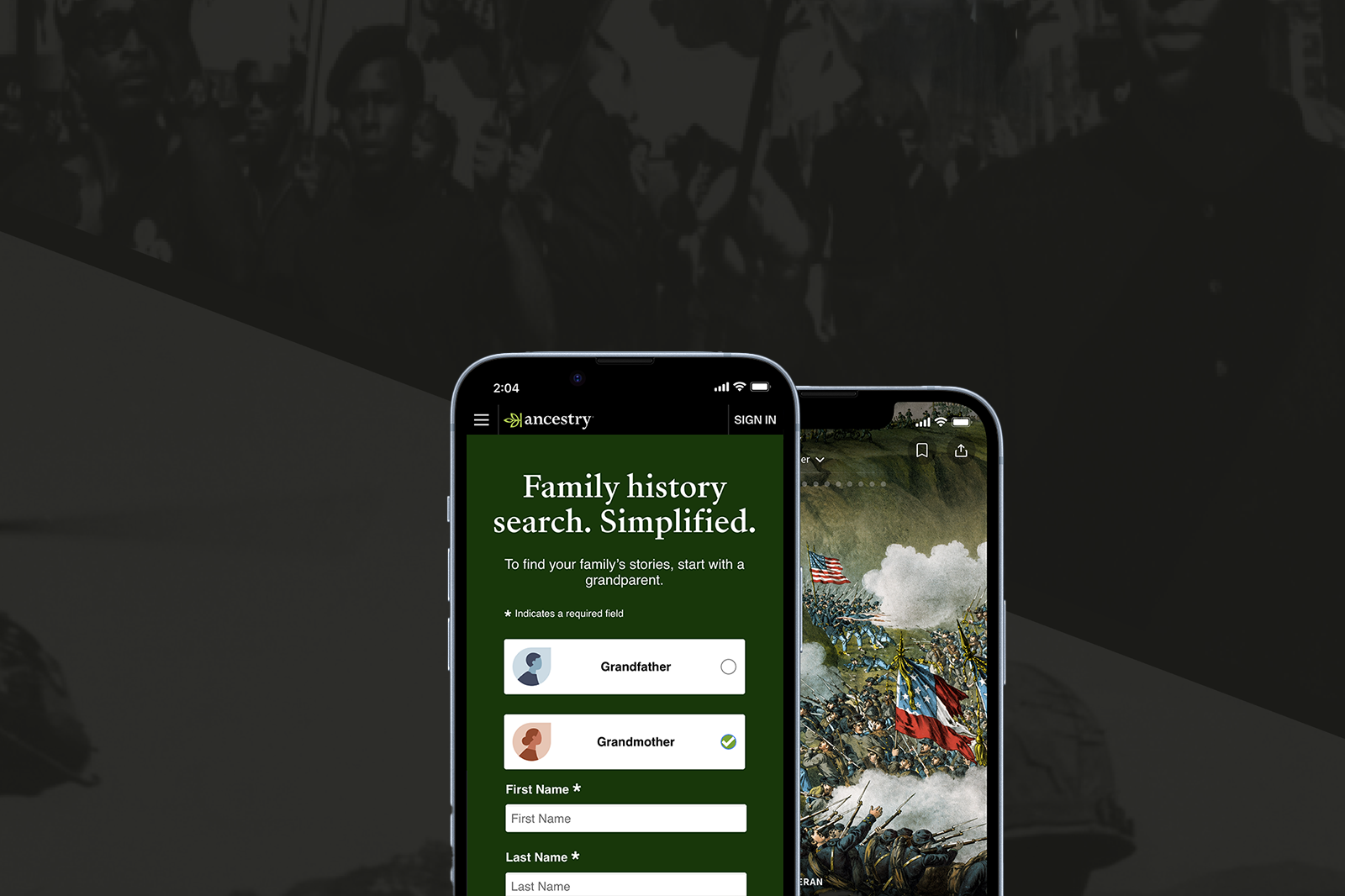
From one grandparent to a family story: enter a grandparent's name and where they lived, and StoryScout finds an ancestor like Henry Ackley, a Union veteran of the Civil War.
Problems
Ancestry's core experience is building a family tree, which means recalling details, entering them by hand, and knowing how to research. That's where new users stalled: 75% of new users never created a tree, or only added their grandparents.
We focused on a segment we called "Family History Curious": people aged 25–44, mobile-first, who love family stories but don't expect to do research. Potentially around 35 million new users in the US alone.
A proof of concept connecting people to historical events, like the Mayflower, validated the need. "This is incredible! I have ancestors who were on the Mayflower?"
What interviews showed
Novices expect Ancestry to already know who they are
They don't know how to find ancestors to add
They're unsure what historical records are telling them
Terms like "2nd cousin twice removed" lose them
Turning research into strategy
I partnered with the PM and leadership to translate research into four workstreams, each tied to a core problem novices faced. Together they cover the whole journey, from getting started to coming back, so a newcomer never hits a dead end.

01 Building a tree
Problem: They expect Ancestry to already know who they are, and don't know how to find ancestors

02 Presenting lineage
Problem: They don't understand terms like "2nd cousin twice removed"

03 Writing stories
Problem: They're unsure what historical records are telling them

04 Organizing stories
Problem: Discovered stories had no clear home to revisit
Key decisions
Decision 01 · Building a tree
Anchor everything on grandparents
Instead of asking people to search records themselves, StoryScout's machine learning does the work. I tested several starting forms and found that a grandparent's name and a place they lived drove the highest completion.
Most people know their grandparents and can verify them, so I made them the anchor for onboarding, lineage, and the story library.
Decision 02 · Presenting lineage
Show only the key connection
Full family trees overwhelmed novices. Looking beyond genealogy, at GitHub branching and computer folder structures, I designed a view that shows just three people: a grandparent you know, the connection in your direct line, and the person the story is about.
Relationships use everyday language ("Mary's brother"), with the full tree a tap away.
Decision 03 · Writing stories
Turn dry records into short stories
Historical records are often handwritten and hard to read. I turned their facts into narratives, and research shaped the format:
Snackable: 50–90 words, one or two sentences per detail
Grounded: historical context, maps, and images make it feel real
Credible: access to the original record built trust and engagement
Light: leaning too far into education caused drop-off
Decision 04 · Organizing stories
Give stories a home, organized by grandparent
Discovered stories were scattered, with no place to revisit them. I organized the "My Family Stories" page around grandparents, so people always have an anchor for finding new stories across their family.
Research showed the layout was easier to understand, and the grandparent model helped people grasp how relatives connect.
A 4-week diary study
After a few iterations, I proposed and ran a four-week diary study with tailored prototypes, to see how people's feelings about StoryScout changed over time.
Where it worked
A great first impression, with a real "in awe" moment
Low effort to learn something valuable about family
Genuine curiosity, and people remembered what they learned
A tree that could carry into Ancestry's core product
Where it fell short
The awe faded after 2–3 weeks as stories got repetitive
Historical images sometimes looked like real family photos
It didn't give people tools to build their own trees
What we did next: since StoryScout's strength was the first impression, we brought it into marketing funnels and targeted campaigns, where a great first moment matters most.
Outcome
~14%
combined lift in subscriptions across verticals
Beat go-to-market goals
converting new users, registrants, and DNA customers into family history subscribers
Strong engagement
with most people who received a story opening it
Scaled into DNA results
as a story and pattern library reused across Ancestry products